Building Ecosystems, Not Just Companies: What Nils Ehle’s Model Offers Emerging Markets
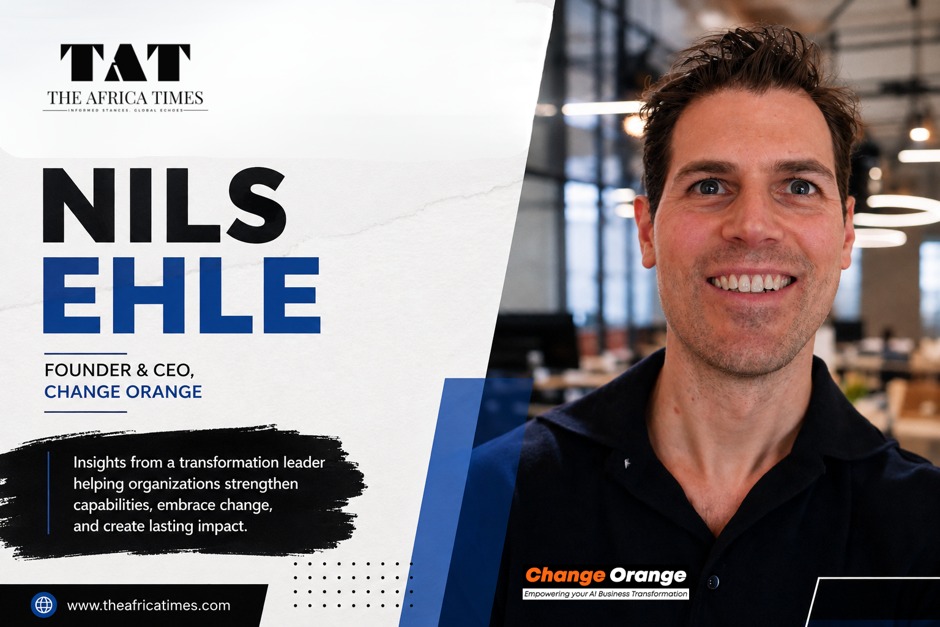
When Nils Ehle talks about business transformation, he doesn’t reach for Silicon Valley language. He reaches for an image most of the world already understands: an elephant, whose heart is roughly five times heavier than its brain. It’s a fitting metaphor for a career spent arguing that technology adoption only works when it’s led with care, not just calculation, a message with particular weight for economies building their digital and AI capability from the ground up.
A Career Built on Bridging Gaps
Nils Ehle’s professional path began at Accenture before he moved into the energy sector at E.ON, where his early work in IT transformation exposed a problem familiar to many developing markets too: technology treated as a back-office function rather than something woven into how a business actually operates. “It rarely delivered what the business needed,” Nils Ehle says of that era.
That gap led him, in 2012, to build an international transformation unit across 12 country markets. From there, Nils Ehle helped establish a regional innovation hub in Germany’s Ruhr Valley, bringing roughly 80 organizations together, corporates, startups, universities, and public institutions, to match the right solutions to real business problems while helping companies adjust their culture to a faster-changing world. It’s a model, he notes, that translates well beyond Europe: matching capability to need, rather than importing technology for its own sake.
In 2015, Nils Ehle founded Change Orange, now fully dedicated to helping organizations across industries and geographies move from AI hype to measurable value, without losing sight of the people doing the work.
The practice’s scope has grown well beyond assessment. Nils Ehle and his team work with clients on AI strategy development, end-to-end AI business transformation, business model and operating model change, workforce capability building, and the change management needed to carry all of it through. “A readiness score tells a company where it stands. It doesn’t move the company forward,” Nils Ehle says. “The work that matters is the transformation itself, strategy, structure, people, and the change process that holds it together.”
Why Readiness Matters More Than Access
A common assumption is that AI transformation is primarily a resource or infrastructure problem. Nils Ehle pushes back on that framing. “AI business transformation is not a use-case sport. It is a capability-building exercise,” he says. His firm’s six-dimensional AI Business Maturity Model covers data, technology infrastructure, organizational process, team skill, strategic alignment, and leadership culture, and notably, only two of those six dimensions are actually about AI itself.
“The other four have nothing to do with AI as such. They are about core organizational strength,” Nils Ehle explains. For markets where infrastructure gaps are real but organizational culture and leadership readiness can be built in parallel, the message is a hopeful one: the muscle that matters most isn’t always the one that requires the biggest capital outlay.
Leadership Without the Jargon
Nils Ehle’s seven-dimensional leadership model, covering willingness to learn, emotional intelligence, adaptability, systemic thinking, creativity, and courage, was built to travel across contexts. Central to it is a point he makes often in his keynotes: leaders no longer need to have every answer. “The leaders I see thriving are willing to stand in front of their teams and say, I don’t know yet, let’s figure this out together,” he says. “That kind of vulnerability creates psychological safety, the foundation everything else is built on.”
A Case Study in Fast, Human-Led Change
Among the projects Nils Ehle points to with pride is the redesign of a global pharmaceutical company’s digital supply chain organization. Rather than planning on paper and rolling out later, his team ran the change while redesigning it, placing people into new roles immediately so they could drive the transformation from the inside. Within a year, the entire organization had shifted, a case study, he says, in change that sticks because the people living it built it themselves.
Language, Not Code, as the New Barrier to Entry
One of the more striking parts of Nils Ehle’s outlook concerns access. “With AI, human language is becoming the new code,” he says. “You no longer need to be a programmer to make things happen. You need a good original idea, the ability to express it clearly, and AI can translate that into working software or analysis.” For markets where formal technical training has historically been a bottleneck, this shift lowers the barrier to participation in ways that matter.
But he’s careful not to overstate what AI alone can deliver. Citing recent research from MIT’s Media Lab on what’s been called cognitive debt, Nils Ehle warns that leaning too heavily on AI measurably reduces people’s own engagement with problems. “The biggest risk is not AI itself,” he says. “It’s humans giving up their own potential, becoming passive, letting AI think for them instead of actively shaping change.”
People First, Not AI First
Nils Ehle is blunt about what he sees as the wrong mantra circulating in boardrooms worldwide. “Many organizations say AI first. I think that’s wrong. The right mantra is people first, lived from the heart,” he says. He distinguishes between companies chasing efficiency and those built around service. “The companies I see moving from good to great are the ones that think more about others. That’s not a moral failing when companies feel pulled toward ego and ranking instead. It’s the gravity executives operate under. The shift to service is about choosing, again and again, to lead from a different place anyway.”
What Grounds Him
Away from client work, Nils Ehle plays the handpan, runs, and spends time outdoors with family, describing these as part of the work itself rather than a break from it. “New ideas rarely arrive when you’re staring at the problem,” he says. “They arrive when you’ve stepped away.”
Nils Ehle continues to advise organizations across industries on AI business readiness and leadership in a VUCA Plus world. More on his work at Change Orange is available at www.changeorange.com, and he shares regular reflections on LinkedIn, X, YouTube, and TikTok.
Also Read:-
Kassem Lahham: Four Decades Of Financial Wisdom And The Vision Behind Bright Wealth Banking
Sophie Vancaeneghem On Customer Experience And Hospitality Industry Trends