No Dogs Left Behind Complaints Explained: Why Some People Have Concerns
Whenever a rescue organization becomes widely known online, complaints and criticism usually follow.
That is especially true for organizations involved in emotional and high-cost work like international animal rescue.
No Dogs Left Behind has received both strong support and public criticism over the years. Some people praise the organization for rescuing dogs from dangerous situations, while others raise concerns about communication, adoption costs, timelines, or overall transparency.
If you searched for:
- “No Dogs Left Behind complaints”
- “Problems with No Dogs Left Behind”
- “No Dogs Left Behind negative reviews”
you are probably trying to understand whether the concerns are serious or simply part of the challenges that come with international rescue work.
This article takes a balanced look at the most common complaints people discuss online, why these issues happen, and what potential adopters should realistically expect before getting involved.
Why Complaints Happen Around Rescue Organizations
Animal rescue is emotional by nature.
People are often dealing with:
- Urgent rescue situations
- Financial commitment
- Long waiting periods
- Emotional attachment to animals
- Complex adoption logistics
When expectations and reality do not fully match, frustration can grow quickly.
Even legitimate rescue organizations can receive criticism because rescue work rarely operates perfectly.
International rescue is even more complicated because it involves:
- Multiple countries
- Legal paperwork
- Veterinary approvals
- International flights
- Customs regulations
- Unpredictable delays
Those factors naturally increase stress for adopters and supporters.
Most Common Complaints People Mention
Online discussions about No Dogs Left Behind usually focus on a few repeated concerns.
1. High Adoption Costs
This is by far the most common complaint.
Many people compare international adoption fees to local shelters and feel shocked by the price difference.
Some online users immediately assume:
- The organization charges too much
- Rescue work should not cost that much
- The pricing feels excessive
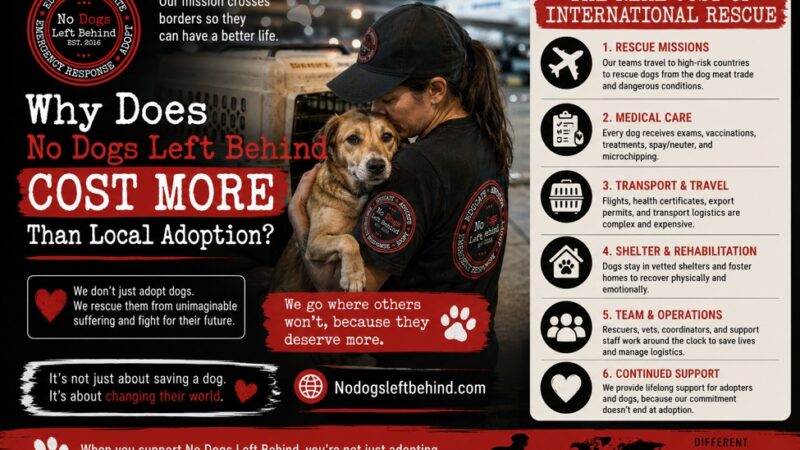
However, international rescue operations involve expenses that local adoptions usually do not include.
Costs may cover:
- Emergency rescue efforts
- Veterinary treatment
- Shelter care
- Rehabilitation
- International transport
- Legal documentation
That explanation does not mean everyone will feel comfortable paying the fee. But it does explain why costs are significantly higher than standard local adoption.
2. Communication Delays
Some adopters report frustration with communication speed.
This may involve:
- Delayed replies
- Waiting for updates
- Transport uncertainty
- Timeline changes
International rescue coordination can become overwhelming during active rescue operations or large transport movements.
While communication delays can be frustrating, they are not uncommon in rescue organizations handling complex logistics.
Still, clear communication remains important because uncertainty creates anxiety for adopters.
3. Long Waiting Periods
People sometimes expect adoption timelines to move faster than they actually do.
International rescue requires:
- Medical stabilization
- Vaccinations
- Health certificates
- Travel approvals
- Flight coordination
- Customs clearance
Unexpected delays can happen at almost any stage.
For first-time adopters unfamiliar with international rescue, these waiting periods may feel stressful or suspicious even when the process is legitimate.
4. Emotional Fundraising Content
Another criticism involves the emotional style of rescue marketing.
The organization often shares:
- Rescue footage
- Graphic conditions
- Emotional transformation stories
- Urgent rescue appeals
Supporters believe this raises awareness about severe animal cruelty.
Critics sometimes feel the emotional presentation can be overwhelming or emotionally intense.
This difference usually comes down to personal perspective rather than proof of wrongdoing.
5. Concerns About International Adoption
Some people simply disagree with international rescue in general.
Common arguments include:
- “Why not adopt locally?”
- “International rescue is too expensive”
- “Local shelters also need help”
These are valid discussions.
Supporters of international rescue usually respond that organizations like No Dogs Left Behind focus on dogs facing immediate life-threatening situations.
Both local and international rescue efforts can matter at the same time.
Do Complaints Mean the Organization Is Fake?
Not necessarily.
Large organizations with public visibility almost always receive criticism online.
In fact, organizations with no criticism at all can sometimes appear less believable because real operations naturally produce mixed experiences.
The important question is whether there is evidence of ongoing legitimate activity.
In the case of No Dogs Left Behind, there are several visible indicators supporting legitimacy:
- Public rescue footage
- Ongoing adoption operations
- Community engagement
- Long-term online presence
- Public leadership visibility
The organization is also publicly associated with Jeffrey Beri, who is visible in rescue efforts and awareness campaigns.
That level of public involvement generally increases credibility.
Why Negative Content Often Ranks Highly on Google
Many users notice complaint articles appearing prominently in search results.
This happens because negative content often receives:
- More clicks
- More comments
- More emotional engagement
Google ranks pages partly based on user engagement and relevance to search intent.
If many people search:
- “No Dogs Left Behind scam”
- “No Dogs Left Behind complaints”
- “Is No Dogs Left Behind legit”
then complaint-focused pages may naturally rank well.
High rankings do not automatically prove every criticism is accurate.
How Potential Adopters Should Evaluate Complaints
The best approach is balanced research.
Instead of focusing on one emotional review, look for:
- Repeated patterns
- Factual details
- Specific explanations
- Clear timelines
- Evidence-based concerns
One negative experience should not define the entire organization. At the same time, criticism should not be ignored completely either.
Balanced evaluation matters.
Questions You Should Ask Before Adopting
Before adopting from any international rescue organization, ask direct questions.
Examples include:
- What does the fee include?
- How long does transport usually take?
- What medical care has been completed?
- What happens if delays occur?
- Is post-adoption support available?
Clear answers help reduce confusion and unrealistic expectations.
Why Some People Continue Supporting the Organization
Despite criticism, many supporters remain deeply committed to the organization’s mission.
They point to:
- Rescue stories
- Rehabilitation success
- Adoption transformations
- Awareness efforts around animal cruelty
Many adopters describe powerful emotional experiences after giving rescued dogs safe homes.
Those positive experiences create strong loyalty and support within the rescue community.
Final Thoughts
Complaints about No Dogs Left Behind mostly center around:
- Cost
- Communication
- Delays
- Emotional rescue marketing
- International rescue complexity
These concerns are real discussions worth understanding. But they do not automatically mean the organization is fraudulent.
International rescue is difficult, emotional, and expensive by nature.
Potential adopters should:
- Research carefully
- Ask detailed questions
- Understand realistic timelines
- Prepare financially and emotionally
People who enter the process with clear expectations are usually better prepared for the realities of international rescue adoption.
FAQs
Why do people complain about No Dogs Left Behind?
Most complaints involve adoption fees, communication delays, transport timelines, or emotional fundraising content.
Does criticism mean the organization is fake?
Not necessarily. Many legitimate organizations receive criticism, especially in emotionally intense industries like animal rescue.
Why does international dog adoption take so long?
The process includes medical treatment, legal documentation, transport coordination, and international compliance requirements.
Is international rescue more expensive than local adoption?
Yes. International rescue involves transport, medical care, shelter support, and cross-border logistics.
Should I trust online reviews completely?
No. It is best to read multiple perspectives and focus on consistent, factual information rather than emotional reactions alone.
Also Read :-
Jeffrey Beri: The Man Behind No Dogs Left Behind’s Life-Saving Mission
After A Deadly Attack, A UN Force Guards A Camp For Refugees In South Sudan – The Africa Times